
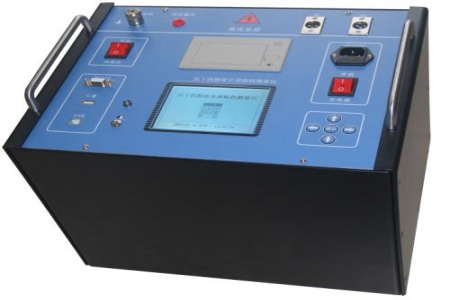
Measurement of contact resistance in circuit breaker conductive loops often yields scattered data due to poor contact conditions of current and voltage leads on site. How can each measurement be made comparable and traceable? The ZHL-200A Intelligent Loop Resistance Tester is designed for the on-site verification needs of technical engineers, with targeted design in current output stability and voltage sampling accuracy. The following explains each aspect from the perspective of engineering parameters.
The device provides two constant current output ranges of 100A and 200A, with a measurement range covering 0–1999μΩ and a resolution of 0.1μΩ. The constant current source adopts closed-loop feedback control, keeping output current fluctuation within ±1% of the set value when load resistance changes. It is suitable for contact resistance measurement of low-resistance loops such as circuit breaker main contacts, disconnector contacts, and busbar joints.
The basic error meets the requirement of 0.5% rd+2d. Before each test, it is recommended to verify the device status using a standard resistor to confirm that the indication deviation is within the allowable range. This step is particularly important at maintenance sites, as it can eliminate systematic deviations caused by oxidized clamps or poor voltage lead connections.
A four-wire measurement method with separate current and voltage leads is adopted. The voltage lead clamps should be clamped inside the current lead clamps to eliminate the influence of lead resistance. After use, the current and voltage leads should be straightened and coiled, and the clamps should be checked for looseness or corrosion. Replace them promptly if poor contact is found to avoid measurement errors introduced by clamp contact resistance.
The device has a built-in storage unit that can save multiple sets of test data and supports query and readback. The sampling circuit adopts digital filtering processing, which has a certain suppression capability against on-site power frequency interference and transient noise generated by switching operations. Reading stability meets the consistency requirements for on-site repeated testing.
It is suitable for contact resistance detection in substation circuit breaker maintenance, switchgear handover tests, and busbar connection parts. During testing, ensure that the circuit under test is de-energized and reliably grounded, and that the current lead cross-section meets the current-carrying requirements for 200A output. The device panel provides wiring diagrams and range prompts to facilitate on-site personnel in completing measurements step by step.

