

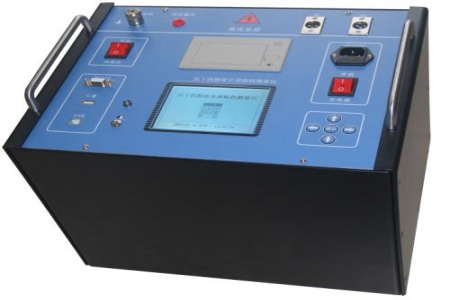
At substation maintenance sites, it is not uncommon for vacuum circuit breakers to show decreased arc-extinguishing capability shortly after being put into operation following a passed withstand voltage test. When the vacuum degree in the interrupter has deteriorated to the 10⁻²–10⁻¹ Pa range, the breakdown voltage may still meet test requirements, and conventional withstand voltage methods can hardly detect such hidden hazards. The VLT-9500 switch vacuum degree tester is designed for this on-site problem. The following answers several questions commonly concerned by technical engineers from the perspective of maintenance and use.
It is recommended to include vacuum degree testing in the periodic maintenance items of circuit breakers and carry it out together with mechanical characteristic and loop resistance tests. For vacuum switches that have been in service for a long time, the testing interval may be shortened. The VLT-9500 has a measurement range covering 9.999×10⁻⁵ Pa to 1×10⁻¹ Pa, with a measurement error of no more than 10%, and can provide a quantitative judgment of the vacuum state of the interrupter, making up for the limitation that the withstand voltage test only reflects the breakdown voltage.
Before testing, confirm that the surface of the interrupter is clean and dry to avoid contamination layers affecting the electric field distribution. When connecting, ensure reliable contact between the test leads and the interrupter terminals, and ground the shielding layer as required by the manual. When ambient humidity is high, the surface of insulating parts may be dried before testing. Multiple measurements of the same interrupter should preferably be carried out under the same working conditions to facilitate longitudinal comparison of historical data. If abnormal fluctuations occur in the measured values, check the wiring and grounding status and retest; it should not be directly concluded that the interrupter has failed.
The equipment should be stored in a dry and ventilated environment, and when not used for a long time, it should be powered on periodically for inspection. Avoid excessive bending of the test cables, and keep the plug parts clean. Send the instrument for calibration according to the calibration cycle to ensure that the measurement error is within the allowable range. Pay attention to shock protection during handling to avoid severe impacts affecting the internal circuits. Wipe the screen and panel with a soft cloth, and do not use corrosive solvents.
When the measured vacuum degree falls within the 10⁻²–10⁻¹ Pa range, even if the withstand voltage test passes, it is recommended to shorten the testing cycle or arrange to replace the interrupter. The measurement results should be comprehensively judged in combination with the number of switch operations and the history of breaking current, and an equipment status file should be formed to provide a basis for maintenance planning.

