

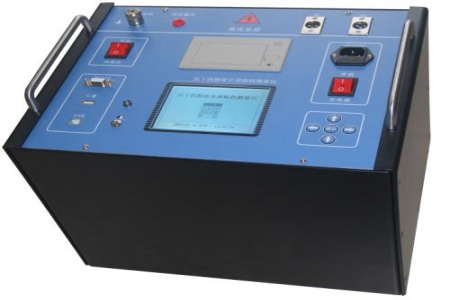
During operation, vacuum circuit breakers often exhibit a situation where the open/close position indicator status is not synchronized with the vacuum degree of the arc-extinguishing chamber: the indication is normal, but the actual vacuum degree is already approaching the critical value. If maintenance personnel rely only on the withstand voltage method, they may easily miss early vacuum degradation. The WDZK-Ⅳ Switch Vacuum Degree Tester provides a disassembly-free measurement solution for this on-site phenomenon.
1. The measurement range covers 10⁻⁴–10⁻¹ Pa, enabling identification of critical states that are difficult to detect with the withstand voltage method, and helping evaluate during selection whether the equipment can detect early degradation.
2. The measurement accuracy is ±5%, providing stable readings within the allowable error range and reducing the workload caused by repeated testing.
3. There is no need to remove the arc-extinguishing chamber on site; measurement can be completed directly on the circuit breaker body, reducing assembly errors and power outage time caused by disassembly.
1. Before each test, confirm the cleanliness of the magnetron or ionization gauge to avoid high readings caused by contamination on the inner wall of the tube.
2. When ambient humidity exceeds 85%RH, it is recommended to suspend testing, or use dry air to blow off the surface of the arc-extinguishing chamber to prevent moisture from affecting the ionization process.
3. The test leads should be reliably connected to both ends of the moving and fixed contacts of the arc-extinguishing chamber. The oxide layer at the connection points must be polished with fine sandpaper; otherwise, contact resistance will introduce measurement deviation.
4. Calibrate the instrument periodically with a standard vacuum tube. It is recommended to send it for inspection every 12 months, and calibration data should be archived for reference.
There are differences in the arc-extinguishing chamber dimensions and contact structures of different models of vacuum circuit breakers. During selection, it is necessary to confirm whether the tester's probe or fixture is compatible with mainstream on-site products. For vacuum switches of 10kV and below, the matching fixture can usually be used directly; for 35kV and above, insulation distance and connection method need to be verified, and if necessary, provide the switch model to the manufacturer to confirm compatibility.
This instrument is suitable for periodic testing in substations, switchgear manufacturing plants, and maintenance workshops. It is recommended to establish ledgers for measured data by switch number, phase, and test date, so as to facilitate longitudinal comparison of the vacuum degree variation trend of the same switch. When the reading approaches 10⁻¹ Pa, a comprehensive judgment should be made in combination with the arc-extinguishing chamber replacement cycle.

