
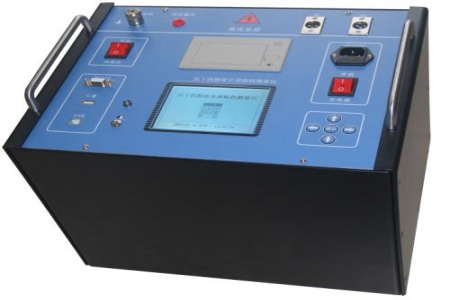
When determining on site whether the vacuum interrupter of a vacuum circuit breaker has failed, two approaches are often encountered: one is the power-frequency withstand voltage method, and the other is removing the interrupter for offline testing. The limitation of the former is that when the vacuum degree deteriorates from 10⁻⁴ Pa to the 10⁻²–10⁻¹ Pa range, the breakdown voltage may still show no obvious drop, yet the interrupter has already entered an unqualified state; the latter requires power outage, disassembly and reassembly, and sending for inspection, resulting in long cycles and high costs. The DRV-8100 Switch Vacuum Degree Tester is aimed precisely at this blind spot in judgment.
The power-frequency withstand voltage method can only reflect the insulation strength of the interrupter and is insensitive to early vacuum degree deterioration. The DRV-8100 adopts the magnetron discharge principle, applies a magnetic field between the interrupter contacts and measures the ion current, and converts it into a vacuum degree value. On-site O&M personnel can complete the measurement on the circuit breaker body without removing the interrupter. The readings cover the 10⁻⁴–10⁻¹ Pa range and can identify critical states missed by the withstand voltage method.
Offline testing requires removing the interrupter from the switchgear and transporting it to the laboratory. The process involves disassembly, packaging, reassembly, and secondary wiring, and the outage time is usually measured in days. The DRV-8100 is a portable design consisting of a main unit and test leads. The overall weight is controlled within a range convenient for one person to carry, and testing can begin once the leads are connected on site. After testing is completed, the vacuum degree value is automatically displayed, eliminating the round trip for sending for inspection.
The instrument is a multi-purpose unit and can adapt to various models of vacuum switch tubes. During use, select the corresponding test parameters according to the interrupter tube type, input the tube diameter and stroke data, and then measurement can be carried out. The testing process is completed automatically by the instrument, and the result is displayed in Pa. For O&M personnel, the key operations are concentrated in two steps: tube type selection and wiring confirmation. During routine inspections, the testing time for a single circuit breaker can be controlled to the order of several minutes.
Before testing, confirm that the circuit breaker is in the open position and reliably grounded. The surface of the interrupter should be kept clean and dry to avoid contamination affecting ion current acquisition. When the measurement result falls within the 10⁻²–10⁻¹ Pa range, even if the withstand voltage test passes, it should be treated as unqualified, and replacement or further diagnosis should be arranged. The instrument should be stored in a dry environment, and the reliability of the test lead connections should be checked regularly.

