
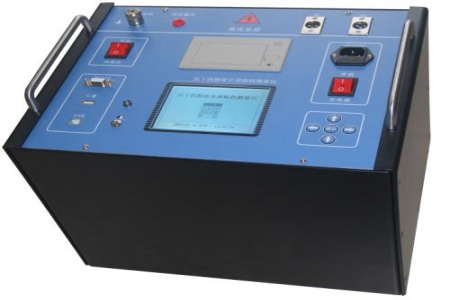
In preventive testing of power systems, the deterioration of vacuum degree in vacuum circuit breaker interrupter chambers is often difficult to detect through conventional withstand voltage tests. When the vacuum degree drops to the range of 10⁻² to 10⁻¹ Pa, although the breakdown voltage does not decrease significantly, the interrupter chamber is already judged as unqualified. Therefore, vacuum degree testing based on the magnetron discharge principle has become a key means of determining the lifespan of interrupter chambers. Below, from the practical application perspective of technical engineers, several common questions are answered.
A: The diameter and tube structure of different types of vacuum interrupter chambers directly affect the correspondence between discharge current and vacuum degree. The KDZ-8 has a built-in parameter table of common tube types, covering various specifications from interrupter chamber diameters ≤φ100 mm to φ160 mm. Before testing, the corresponding tube type must be selected according to the nameplate or actual measurement; otherwise, deviations in ion current collection will cause the calculated vacuum degree results to deviate from the true values. For non-standard tube types, diameter parameters can be entered through the custom function for calibration.
A: The vacuum degree measurement range covers 9.999×10⁻⁵ Pa to 1×10⁻¹ Pa, basically covering the complete range of vacuum circuit breakers from qualified to deteriorated. In the range of 10⁻³ to 10⁻¹ Pa, the pulsed magnetron discharge method is used to infer the vacuum degree by measuring the peak ion current, with repeatability error controlled within ±10%. The device has a built-in temperature sensor that performs real-time compensation for changes in the discharge environment temperature, reducing data fluctuations caused by on-site temperature differences.
A: Substations have strong electromagnetic interference. The KDZ-8 uses differential input and digital filtering in its signal conditioning circuit to effectively suppress common-mode interference. At the same time, the high-voltage output and signal acquisition circuit are isolated by optical fiber to avoid the influence of ground potential differences on measurement results. In practical applications, in substations with voltage levels of 220 kV and below, the deviation between test data and laboratory calibration values usually does not exceed one order of magnitude.
A: First, ensure that the surface of the interrupter chamber is clean and dry; otherwise, surface leakage current will be superimposed on the ion current. Second, the magnetic field coil should be as concentric as possible with the axis of the interrupter chamber; eccentricity will cause uneven discharge. Third, before each test, it is recommended to use a standard vacuum degree tube for verification to confirm that the device is in normal condition. The KDZ-8 provides a one-key calibration mode to simplify the on-site verification process.
A: The instrument has a built-in memory that can store no fewer than 200 sets of test data. Each set of data includes tube type, vacuum degree value, test time, and ambient temperature. Through the USB interface, data can be exported to a computer, making it convenient to establish a vacuum degree trend file for interrupter chambers. For multiple test results of the same circuit breaker, longitudinal comparison can be used to determine the rate of change in vacuum degree.

