
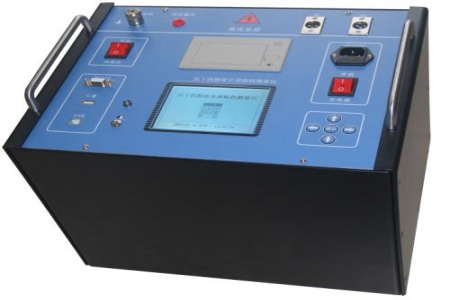
Design and selection personnel often focus on the instrument's resolving capability in the low-resistance range and its coverage capability in the high-resistance range. The DRD-6600 DC Resistance Tester covers a measurement range of 1mΩ to 20kΩ, with a basic accuracy of ±0.2% reading ±2 digits, and a resolution of up to 1μΩ in the 1mΩ range, which can meet the measurement requirements for contact resistance of circuit breaker conductive circuits, disconnector contacts, busbar joints, and other parts. For loads with relatively higher resistance such as transformer windings, testing can also be completed within the same range framework. During selection, the resolution and accuracy specifications of the instrument in commonly used ranges should be confirmed based on the resistance distribution of the object under test to determine whether they meet the judgment requirements.
The DRD-6600 provides six test current levels: 1A, 5A, 10A, 20A, 50A, and 100A. Selection personnel can choose the appropriate level according to the rated current and resistance of the circuit under test. Lower current levels are suitable for measuring inductive loads such as transformer windings, while higher current levels can improve the signal-to-noise ratio of low-resistance circuits. The instrument has a built-in automatic discharge circuit that automatically releases the charge of energy storage components after testing, reducing operational risks. The constant current output method helps reduce the influence of test lead resistance and contact resistance on measurement results.
The DRD-6600 has an operating temperature range of -20 to 40°C and an ambient humidity of ≤85%RH, meeting the general environmental conditions of substation maintenance sites and switchgear production assembly lines. The instrument adopts AC/DC dual power supply, and the built-in lithium battery pack can support continuous measurement for about 4 hours, making it convenient for use on sites without external power supply. During selection, the on-site power supply conditions and continuous working time requirements should be considered to confirm whether the battery endurance meets the single work cycle. It is recommended to perform a standard resistance comparison every six months to confirm that the measurement deviation is within the allowable range.
The instrument is equipped with a 3.5-inch color LCD screen, supports Chinese menu operation and measurement data storage, and can save 500 sets of test records. Data can be exported to a computer via a USB interface for subsequent analysis and report generation. Selection personnel should pay attention to data storage capacity, export format, and host computer software compatibility to ensure connection with the existing management system.

