
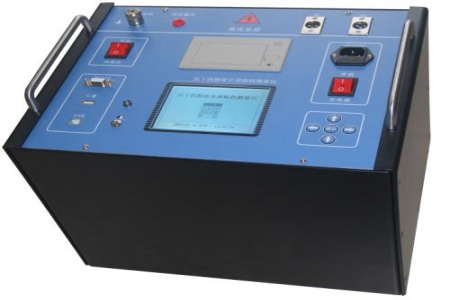
At the maintenance site of a substation switchgear, technical engineers need to quickly determine the contact condition of the circuit breaker's conductive circuit. The DRD-80C DC Resistance Tester uses a constant current source to apply high-precision current, collects test voltage and current data, and obtains the actual resistance value after processing by the central control unit. It is suitable for measurement scenarios such as switch contact resistance and transformer winding DC resistance.
Conventional portable multimeters or low-current resistance testers are susceptible to contact potential and lead resistance interference when measuring micro-ohm-level loop resistance, and data repeatability is limited. The DRD-80C outputs a stable test current through a built-in constant current source and adopts a four-wire measurement method, effectively reducing the influence of lead resistance. Compared with similar equipment, this instrument has a maximum power consumption of 300 W in the 2 Hz low-frequency test mode, balancing test accuracy and on-site power supply conditions; if an enhanced power module is selected, the power consumption can be extended to 500 W or 1200 W to adapt to different load requirements.
The instrument has an operating temperature range of -10°C to 50°C, which can meet the use requirements of outdoor maintenance in northern winters and high-temperature environments in power distribution rooms in summer. During storage, avoid moisture, corrosive gases, and strong vibration; it is recommended to place it in a dry and ventilated place. During on-site operation, first connect the test leads reliably, then start the test, and read the resistance value after it stabilizes; after the test is completed, turn off the power promptly and organize the cables.
The DRD-80C DC Resistance Tester is mainly used for switch contact resistance testing, loop resistance testing, and transformer winding DC resistance measurement. In routine circuit breaker maintenance, it is used to determine contact wear or poor contact by measuring the conductive loop resistance; in transformer handover tests, it is used to check winding welding quality and tap changer contact condition.

