
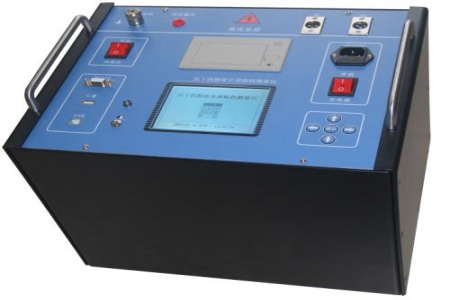
At the main transformer maintenance site of a substation, operation and maintenance personnel often need to complete winding DC resistance measurement within a limited power outage window and determine whether the three-phase unbalance rate exceeds the standard. The DRD-200C DC resistance tester is designed for such scenarios, with multiple adjustable output current levels and a range covering 1μΩ to 20kΩ, suitable for measuring transformer windings, motor coils, and switch contact resistance.
Some DC resistance testers use fixed current output and rely on an external discharge rod to assist discharge when measuring large inductive windings, which involves more operating steps. The DRD-200C uses a constant current source together with an automatic discharge circuit to automatically release the winding stored energy after the test, reducing on-site waiting time. Compared with conventional handheld instruments that provide only currents below 10A, this model can select the 10A current range in the low-resistance section below 1mΩ, reducing the influence of lead contact resistance on readings; in the high-resistance section above 100Ω, it automatically switches to a small current range to balance reading stability.
The operating ambient temperature range is -10 to 40°C, and the relative humidity is ≤85%RH, adapting to most outdoor switching stations and transformer room environments. The power supply supports AC 220V±10% or an built-in lithium battery pack, allowing continuous operation for about 4 hours in maintenance intervals without an external power source. The measurement accuracy is ±(0.2% reading + 2 digits), with a resolution of 1μΩ, meeting the reading requirements of transformer handover tests and preventive tests. Compared with some models in the same range segment, this instrument centrally displays the discharge indication and measurement circuit status on the panel, making it easier for operation and maintenance personnel to confirm that the circuit has completed discharge before disconnecting and reconnecting leads.
The instrument panel has current terminals and voltage terminals arranged separately. The four-wire connection method can reduce the interference of lead resistance and contact resistance on measurement results. During measurement, the screen displays both the measured resistance value and the reference value converted to 75°C, eliminating the need for manual conversion on site. Compared with solutions that rely on external printers or host computers to record data, this model has built-in storage that can save 200 sets of test data and supports retrieval by date, making it suitable for operation and maintenance personnel to uniformly fill in records after completing tests on multiple devices.
Note: The above information and technical parameters are compiled and published by Yangzhou Darui Electric Co., Ltd.

