

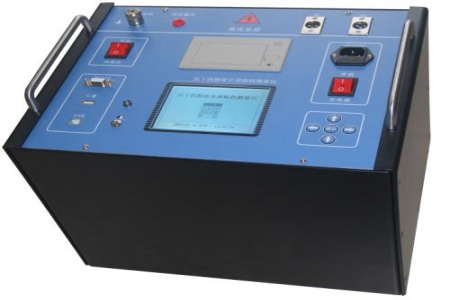
The CRD-20C DC resistance tester is designed for low-resistance measurement scenarios such as transformer windings, motor stators and rotors, switch contact resistance, and cable conductors. It adopts a constant-current source four-wire measurement method and is suitable for comparative analysis of the same measured object under multiple current ranges. The following points explain several aspects worth checking when comparing and selecting this model.
The nominal measurement accuracy of this model is 0.2%±. In actual use, attention should be paid to the correspondence between accuracy and range settings. For the low-resistance section, it is recommended to use a larger test current to improve the signal-to-noise ratio, while for the high-resistance section, attention should be paid to the minimum resolution. When comparing, do not only look at the accuracy figure; it is also necessary to check the indication error at specific range points and the last-digit jumping situation to avoid reading drift near the critical range.
The CRD-20C provides multiple test current output ranges and can manage fast charging and discharging of inductive loads. When comparing similar models, attention should be paid to the continuous output capability under high-current ranges, charging stabilization time, and the protection design of the discharge circuit. For large inductive loads such as transformer windings, charging time and back-EMF absorption capability directly affect the efficiency of a single measurement.
Power frequency and high-frequency interference exist on site in substations and distribution rooms, so the instrument needs corresponding filtering and shielding measures. When comparing, pay attention to its digital filtering method, display refresh rate, and consistency of multiple measurements. For occasions requiring repeated measurements, it is recommended to check the temperature drift performance of the instrument under continuous operation.
This model uses a combination of panel buttons and liquid crystal display, and supports storage and review of measurement data. When comparing and selecting, confirm whether it has phase-separated measurement records, data export interfaces, and power-off protection capability, so as to facilitate on-site recording and subsequent review.
It is suitable for power maintenance, transformer manufacturing, and motor factory inspection, among other processes. The length and diameter of the supporting test lines and the contact resistance of the clamps have a practical impact on measurement results. It is recommended to select the corresponding line set according to the resistance range of the measured object and to perform line resistance zero calibration before use.
Note: The above technical parameters are compiled and published by Yangzhou Darui Electric Co., Ltd. The actual product manual shall prevail.

