

After a substation grounding grid has been in operation for many years, the measured grounding impedance often differs from the design value. The core issue for procurement personnel is: what kind of equipment can accurately measure parameters such as grounding impedance, surface potential gradient in the site area, touch voltage, and step voltage, with traceable data. DL/T 475 "Guide for Measurement of Characteristic Parameters of Grounding Devices" sets specific requirements for current injection methods, wiring length, and anti-interference capability in large grounding grid testing, and instrument selection needs to be carried out around these requirements.
The first type of question is that measurement results are greatly affected by power-frequency interference. During large grounding grid testing, the distance between the test current injection point and the voltage electrode is long, and operating power lines exist nearby, so power-frequency interference easily couples into the measurement loop and causes reading fluctuations. The second type of question is that test items are scattered. Grounding impedance, grounding resistance, grounding reactance, transferred potential, grounding down-conductor continuity resistance, and soil resistivity each use different instruments, resulting in high procurement and on-site carrying costs. The third type of question is that equipment is bulky and operation is complex, and on-site personnel need a relatively long time to become familiar with wiring and parameter settings.
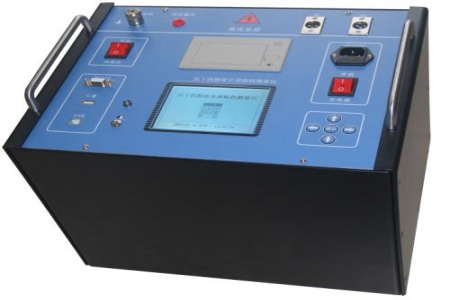
The DRD-85T Large Grounding Grid Tester adopts a variable-frequency measurement method, reducing the impact of on-site power-frequency interference by using a test frequency deviating from the power frequency, with an AC impedance measurement range of 0–999.9Ω. The instrument can measure parameters such as grounding impedance, grounding resistance, grounding reactance, surface potential gradient in the site area, touch potential difference, touch voltage, step potential difference, step voltage, transferred potential, grounding down-conductor continuity resistance, and soil resistivity, covering the main items of large grounding grid testing with one device. The instrument uses a Chinese liquid crystal display, measurement results can be read directly, and it has a printing function, facilitating on-site recording and archiving. The whole machine weighs about 9.0kg and is relatively small in size, making it suitable for handling and operation at substations, power plants, and other sites.
This instrument is suitable for measuring grounding characteristic parameters of large grounding grids such as those in substations, power plants, and converter stations, and can also be used to evaluate the effectiveness of grounding renovation projects. When selecting a model, procurement personnel can combine the test item list, on-site interference conditions, and wiring conditions to confirm whether the measurement range and frequency settings meet the requirements.

