

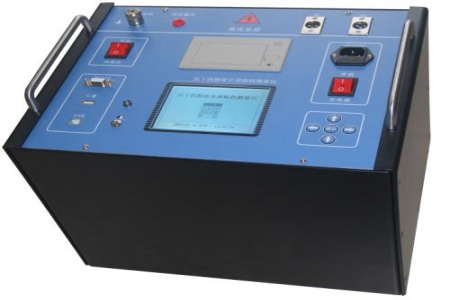
During design and selection, a common question arises: for measuring the loop resistance of switch control equipment, how much output current should the instrument provide to be sufficient? If the current range is selected too high, the equipment size and cost increase; if selected too low, the test current is insufficient to break down the oxide film on the contact surface, resulting in poor repeatability of the measured data. The output current range of a loop resistance tester directly affects the stability of measurement results and on-site applicability.
The HLD-200E offers four selectable output current ranges: 50A, 100A, 150A, and 200A. Compared with testers having a fixed single current range, the four-range design allows selection personnel to flexibly choose the test current according to the rated current of the switch under test and the condition of the contact surface. For small and medium-capacity switches, the 50A or 100A range is sufficient to meet measurement requirements; for large-capacity switches or occasions where the contact surface is heavily oxidized, the 150A or 200A range can be selected. This range-based approach avoids the unnecessary power consumption of single-range high-current instruments during light-load testing, and also reduces the thermal effect on the tested contacts caused by excessive test current.
The instrument operates on AC 220V±, with the operating current designed for AC 220V power supply conditions. Compared with portable solutions using battery power, AC 220V power supply ensures continuous output capability at high current ranges, making it suitable for use in maintenance workshops or fixed locations within substations where mains power is available. During selection, it is necessary to confirm whether 220V AC power is available on site; if work is required in areas without mains power, an alternative power supply solution should be considered separately. The instrument is suitable for measuring the loop resistance of switch control equipment, including the contact resistance of circuit breakers, disconnectors, busbar connections, and other parts.
For design and selection scenarios focused on preventive testing and handover testing, it is recommended to first confirm the capacity range and testing frequency of the switch under test. If the objects under test cover multiple specifications, the HLD-200E with four adjustable ranges offers a relatively balanced adaptability; if only specific small-capacity switches are involved, a model with a smaller current range can be selected to control costs. For specific range, resolution, and accuracy specifications of the instrument, please refer to the accompanying technical manual, and selection should be verified against the rated parameters of the object under test.

