

DL/T 845.4—2018 "General Technical Specifications for Resistance Measuring Devices Part 4: Loop Resistance Testers" stipulates that the measuring current shall not be less than 100A, a DC power supply is recommended, and the ripple coefficient shall not exceed 1%. On-site operation and maintenance personnel often encounter two types of problems: first, the oxide film on switch contacts is not effectively broken down, resulting in measured values that are too high; second, pulsed power supplies are used, and the short current duration cannot reflect the true loop resistance. In addition, poor contact between the measuring clamp and the terminal, as well as mutual interference between current leads and voltage leads, can also cause data fluctuations.
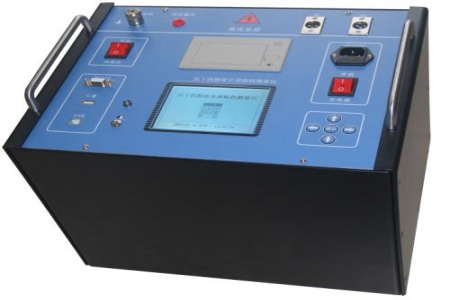
The HLC-150A Loop Resistance Tester adopts switching power supply technology and can continuously output a 150A DC test current with a small ripple coefficient. Compared with pulsed instruments, continuous high current can more fully break down the oxide film on contact surfaces and obtain stable contact resistance values; compared with ordinary DC micro-ohmmeters, the 150A output is more suitable for measuring low-resistance, large-cross-section connection parts such as circuit breaker main circuits and disconnector contact fingers. The instrument has built-in data storage and a printing interface, facilitating on-site recording.
Measuring range: 0~4mΩ, resolution 1μΩ; test current: 100A/150A two ranges; accuracy: ±(0.5% reading + 0.5μΩ); working power supply: AC220V±10%, 50Hz. The panel is equipped with a power switch, measurement switch, current adjustment knob, power socket, current output I+, current output I-, measurement input V+, measurement input V-, and grounding terminal. The current leads and voltage leads are connected separately to reduce the influence of contact resistance.
Suitable for substations, power plants, switchgear production workshops, and other locations, for loop resistance measurement of circuit breaker main circuits, busbar connectors, and disconnector contacts.

