

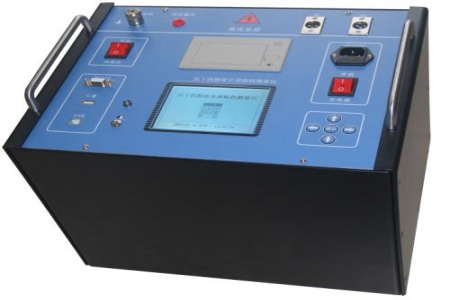
During design and selection, how can the loop resistance range of the switch under test be quickly matched with the required test current? This is a common problem encountered by selection personnel. Loop resistance testers are used to measure the contact resistance of switches, circuit breakers, busbars, and other equipment, and their output current capability directly affects the stability of the measurement results. The following Q&A is organized around application scenarios for selection reference.
This instrument is mainly used for contact resistance measurement of high-voltage switches, circuit breakers, and disconnectors in power systems, and is also suitable for resistance detection of low-resistance loops such as busbar connection points and cable joints. In substation maintenance, switchgear factory tests, preventive tests, and other stages, measuring loop resistance can determine whether the contact state of the contacts is good and help identify hidden hazards such as oxidation, wear, or poor fastening.
The HL-100P provides a 100A DC test current, with a measurement accuracy of class 0.5. At 100A current, the reading is stable and repeatability is good, making it suitable for measuring switches with contact resistance at the micro-ohm level. The test current can be selected according to the loop resistance range of the object under test. If the loop resistance is relatively large, a lower current range can be selected to ensure stable readings. The operating current is AC220V±10%, adapting to on-site power supply conditions.
The instrument uses a liquid crystal display, allowing direct reading of resistance values, current values, and test status. It has a built-in printing function, which can output results after testing is completed, facilitating on-site recording and archiving. The operating temperature range is -10℃~50℃, which can meet the usage needs in most outdoor or switch room environments.
It is recommended to first confirm the rated current and typical loop resistance range of the switch under test, and then check whether the test current matches. If the loop resistance under test is below 100μΩ, 100A current can provide sufficient resolution; if the resistance is relatively high, the correspondence between current and range needs to be evaluated. At the same time, pay attention to the instrument's resolution, measurement range, and anti-interference capability to ensure compatibility with the on-site electromagnetic environment.
The HL-100P loop resistance tester, with 100A DC output and class 0.5 accuracy as its basic configuration, is suitable for routine measurement and operation and maintenance testing of switch contact resistance.

