
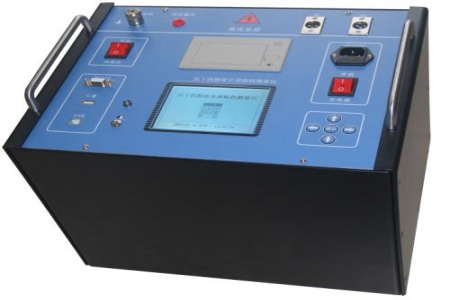
During on-site testing of circuit breaker loop resistance, problems such as large data fluctuations, poor repeatability, and even overestimation of contact resistance due to insufficient test current are often encountered. Such problems directly affect the judgment of contact status in operation and maintenance. The HLY-300A Loop Resistance Tester addresses these practical pain points with adjustments in current output and measurement algorithms, making it suitable for switch maintenance and routine testing.
At present, there are mainly two types of common on-site loop resistance testing solutions: one is the traditional DC double-arm bridge, which requires manual balance adjustment, is cumbersome to operate, and has a small output current (usually a few amperes), making it difficult to break down the oxide film on contacts and resulting in larger measured values; the other is ordinary switch contact resistance testers, mostly with 100A or 200A output, which have limited anti-interference capability and obvious reading fluctuations when measuring long busbars or large-capacity switches. The HLY-300A provides 300A constant current output and can operate continuously from 5 seconds to 599 seconds, offering better penetration through oxide layers on large cross-section contacts and busbar connections. Compared with 100A equipment, the contact resistance measured at 300A output is closer to the true value and has better repeatability; compared with the double-arm bridge, it requires no manual zero adjustment and enables one-key measurement, reducing human reading errors.
The device adopts a large-screen Chinese LCD display, allowing operation and maintenance personnel to quickly read resistance values, test current, and duration. In daily maintenance, attention should be paid to the following: test leads should be inspected regularly; if oxidation or looseness occurs at the alligator clips and plugs, additional contact resistance will be introduced, causing measurement deviation; current leads and voltage leads should be connected separately to avoid mutual interference. Before each test, it is recommended to verify the device status with a standard resistor and confirm that the accuracy meets the requirement of 0.5% rd+2d. If not used for a long time, it should be charged once every three months to maintain battery activity.
The HLY-300A is suitable for contact resistance measurement of high-voltage circuit breakers, disconnectors, busbar connectors, and welded joints. During measurement, ensure that the equipment under test is in a power-off maintenance state and reliably grounded. During testing, if abnormal fluctuations in readings are found, check whether the test leads are firmly connected and whether the contact surfaces are clean. For outdoor equipment, try to avoid measurement in environments with humidity greater than 85% to prevent surface leakage from affecting the results. The device internally uses dual-channel high-speed 16-bit Σ-Δ analog-to-digital converters, providing stable readings and good repeatability, and is suitable for operation and maintenance personnel to quickly judge contact status on site.

