

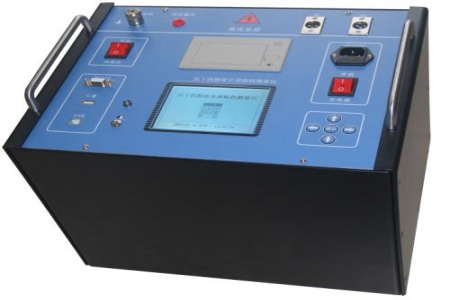
During inspections of main transformers in substations, operations and maintenance personnel often encounter situations like this: the online monitoring device frequently alarms, but after oil samples are taken and retested, the fault gas content is not actually above the limit. Such false alarms are often related to degassing efficiency, chromatographic column separation performance, or sensor drift. When selecting equipment, long-term stability and maintenance convenience should be key considerations. The following uses the DRD-9100 online transformer oil chromatography monitoring device as an example and compares it with common similar solutions.
Common devices mostly use bubble degassing or membrane degassing. The former is easily affected by oil temperature fluctuations, while the latter may cause membrane module blockage under negative pressure due to moisture in the oil. The DRD-9100 adopts a built-in oil circulation system together with vacuum degassing to complete oil-gas separation under constant temperature conditions, reducing interference from the degassing step on measurement repeatability. Compared with solutions requiring an external oil pump, the built-in circulation structure reduces on-site pipeline connection points and lowers the risk of leakage.
A composite chromatographic column can separate six fault gases—H2, CO, CH4, C2H6, C2H4, and C2H2—under a certain temperature environment. Some early devices experience peak area drift when ambient temperature changes, causing peak capture conditions to require repeated adjustment. The DRD-9100 stabilizes its constant temperature control system at 40°C±0.5°C, keeping the peak areas of each gas consistent and facilitating stable peak capture by data processing algorithms. In contrast, devices without constant temperature measures or with insufficient temperature control accuracy often require more frequent manual intervention at sites with large day-night temperature differences.
It is recommended that the detection unit be calibrated once every 6 months using a standard mixed gas. Before calibration, confirm that the temperature control system is stable at 40°C±0.5°C; otherwise, the calibration results may deviate. Compared with devices that have unclear calibration cycles and require factory calibration, the DRD-9100 can be calibrated on site, and operations and maintenance personnel only need to perform it according to the cycle, reducing equipment downtime for shipment and inspection.
For on-site operations and maintenance personnel, degassing method, constant temperature accuracy, and calibration cycle can be used as items for horizontal comparison during selection. The DRD-9100 uses vacuum degassing, a dedicated composite chromatographic column, temperature control accuracy of ±0.5°C, and a calibration cycle of 6 months. The above parameters can serve as a basis for comparison with similar devices. Specific selection still needs to be comprehensively judged in combination with on-site oil quality conditions and maintenance schedules.

