

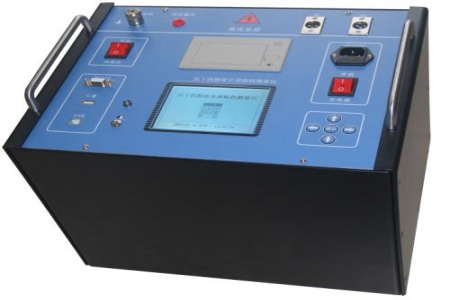
Waveform abnormalities, excessive transition resistance, or three-phase synchronism deviations during the switching process of an on-load tap-changer are often difficult to detect through visual inspection. Field O&M personnel need dedicated instruments to dynamically record the switching process in order to determine whether the tap-changer operates properly. The DRD-8700 On-Load Tap-Changer Tester is designed for such requirements and can measure transition resistance, transition time, three-phase synchronism, and switching waveforms within a single instrument.
Traditional methods mostly use an oscilloscope recorder together with a shunt for time-division acquisition, which involves cumbersome wiring and requires manual waveform analysis; some early test devices can only measure transition resistance and cannot simultaneously record three-phase synchronism. The DRD-8700 adopts a multi-channel synchronous sampling architecture, in which three-phase switching signals enter the acquisition unit simultaneously, avoiding the phase errors caused by time-division measurement. Compared with single-parameter testers, this instrument integrates transition resistance and transition time measurement into the same process, reducing the number of repeated wiring operations on site.
During on-site selection, the following indicators should be checked carefully: the sampling rate affects the ability to restore waveform details, and the DRD-8700 has a sampling rate of 10 kS/s; the number of signal channels is three independent acquisition channels, supporting simultaneous three-phase connection; the transition time measurement range is 0.1 ms to 500 ms, and the transition resistance measurement range is 0.1 Ω to 50 Ω; the synchronism measurement error is no greater than 0.1 ms. The above parameters cover the switching characteristic test requirements of common on-load tap-changers. The instrument has built-in waveform storage and playback functions, facilitating preliminary on-site judgment and subsequent analysis.
During testing, connect the three-phase test leads to the corresponding contacts of the tap-changer respectively, set the sampling parameters, and then perform one complete switching operation; the instrument automatically records the resistance change curve and time markers during the switching process. O&M personnel can judge from the waveform whether there are abnormal spikes in transition resistance and whether the three-phase operations are synchronized, and export the data for subsequent comparison. The instrument is suitable for routine inspection, handover acceptance, and troubleshooting of transformer on-load tap-changers.

