
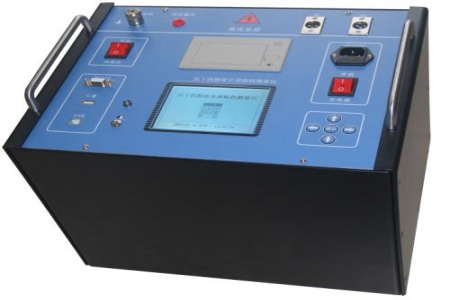
At substation maintenance sites, operators often find that after a vacuum circuit breaker operates, the vacuum interrupter shows no external abnormalities, but its breaking capacity may have already decreased. The HDZK-IV switch vacuum degree tester addresses this situation by providing a vacuum degree detection method that does not require disassembling the interrupter, helping to determine whether the interrupter needs further handling.
The instrument features a multi-purpose design and can measure various types of vacuum switch tubes. Before use, confirm that the interrupter surface is clean and free of stains to avoid affecting electric field distribution. Check whether the test line clamps are intact and the grounding terminal is reliably connected. If the switch tube under test has substitutable parameters, the corresponding mode can be directly selected; if not, press the [Select Key] to make [◢◢] point to the corresponding option and manually input the tube type parameters. Note that ambient humidity should not be too high, otherwise measurement stability may be affected.
Reliably connect the high-voltage output terminal to the moving and fixed contacts of the interrupter to ensure good contact. After starting measurement, the instrument automatically completes pressurization, sampling, and calculation. Operators should pay attention to whether the displayed value is within the range of historical data; if the deviation is obvious, measurement should be repeated once. During measurement, avoid personnel approaching the high-voltage terminal to prevent induced electricity. If the interrupter is reinstalled into the circuit breaker, mechanical parameters need to be adjusted, which is labor-intensive and requires professional personnel; therefore, it is recommended to complete the test before disassembly.
The instrument should be stored in a dry, ventilated environment free of corrosive gases. When not in use for a long time, power it on for inspection every three months. Avoid excessive bending of the test lines and keep them clean. If abnormal display or key failure is found, do not disassemble it yourself; contact professional personnel for handling. Calibrate the instrument regularly to ensure credible measurement results.

