
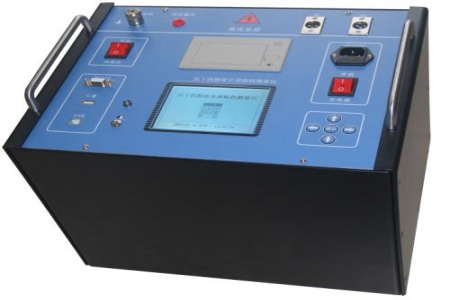
A DC resistance tester provides a constant current source for the equipment and calculates resistance by measuring current and voltage drop. The ZDR-30A Intelligent Loop Resistance Tester has higher output current capability than common 10A and 20A specifications. In its AC power supply mode, a 2Hz test frequency corresponds to a maximum power consumption of about 300W, and it can output a 30A test current. Compared with low-current models, the 30A output can establish a stable magnetic field more quickly and shorten measurement time, making it suitable for measurement scenarios with low resistance values that require high-current excitation, such as high-voltage switch and circuit breaker loop resistance. For assembly-line batch inspection, current output capability directly affects the time required for a single measurement, and the ZDR-30A has a certain advantage in speed.
Common DC resistance testers mostly use a 3 1/2 digit LED display. The ZDR-30A maintains the same display method but uses microcontroller control internally. Compared with early instruments using pure hardware circuits, the microcontroller solution reduces the analog potentiometer adjustment step and lowers human reading errors. During operation, it is only necessary to connect the test leads and start the measurement, and the instrument automatically completes range switching and data hold. For assembly-line positions that need to record data frequently, this automatic process can reduce operating steps and improve consistency. Compared with smart models with complex menus, the ZDR-30A focuses more on fast measurement and reliability, with functional trade-offs偏向 on-site basic needs.
Some DC resistance testers have a relatively narrow rated operating temperature range, while the ZDR-30A supports operation under ambient temperatures from -20℃ to +45℃ and humidity ≤85%. Compared with ordinary commercial instruments, this lower temperature limit can cover outdoor maintenance scenarios in northern winters, and the upper limit meets the high-temperature environment of summer distribution rooms. In power maintenance, switch manufacturing, and other occasions, ambient temperature fluctuations are common, and the wide-temperature design reduces situations where the instrument cannot start due to low temperature or drifts due to high temperature. It should be noted that the instrument is AC-powered, and a matching power interface must be provided on site.
Digital micro-ohmmeters usually focus on micro-ohm-level resolution, while the ZDR-30A is positioned to measure loop resistance at 30A current, making it suitable for switch contact resistance measurement with clear requirements for test current. Compared with 100A or 200A loop resistance testers, the 30A model is relatively smaller in size and power consumption, making it suitable for maintenance sites with limited space. When selecting a model, technicians should make a comprehensive judgment based on the resistance range of the equipment under test, the required test current, and the power supply conditions. For occasions with lower rated current or low test frequency, the 30A output can balance efficiency and portability.

