

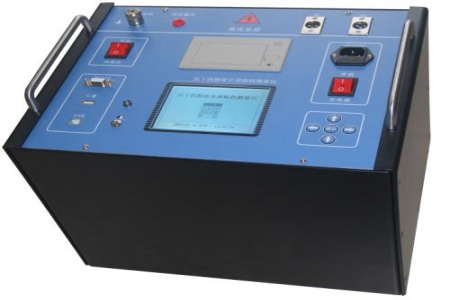
When purchasing a partial discharge tester, procurement personnel can prioritize checking the instrument's voltage measurement range, elliptical time-base adjustment capability, and anti-interference level. The JFD-8000 digital partial discharge tester supports adjusting the high-frequency time-base ellipse to normal display under an input voltage of 10–250V, with low power consumption, making it suitable for on-site and laboratory environments. Its stable operating voltage is 220V AC, and the digital voltmeter indication accuracy is better than ±1%, providing basic data for determining partial discharge magnitude. The instrument adopts digital signal processing, reducing human reading errors and facilitating unified training and maintenance after bulk procurement.
The instrument has multi-channel synchronous acquisition capability, allowing simultaneous monitoring of three-phase or different measurement point signals. The high-frequency time-base elliptical display mode helps observe discharge phase distribution and assists in determining discharge types. The built-in digital voltmeter displays the test voltage in real time, with a range covering 10–250V, meeting the partial discharge test requirements of conventional transformers, GIS, cables, and other equipment. The device provides analog and digital output interfaces for easy connection to external recording devices or host computer software. The overall power consumption is low, making it suitable for long-term continuous operation.
The JFD-8000 is suitable for partial discharge detection of power equipment such as transformers, GIS, switchgear, cables, and instrument transformers. During procurement, the number of channels and sensor interfaces should be confirmed according to the type of test object; if the focus is on on-site inspection, attention can be paid to portability and anti-electromagnetic interference design; if used for quantitative analysis in the laboratory, it is recommended to check the voltage measurement accuracy and time-base adjustment range. The instrument is powered by 220V AC, and the digital voltmeter indication accuracy is better than ±1%, which can meet the requirements of most preventive tests and handover tests. When selecting, the supporting calibration pulse generator and shielded room conditions should also be confirmed to ensure consistency of measurement results.

