

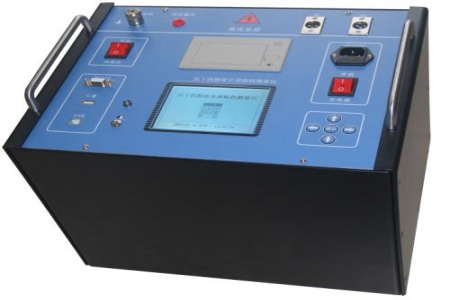
The large grounding grid tester is used for on-site measurement of parameters such as grounding resistance, soil resistivity, and grounding grid impedance in power plants, substations, and other locations. Based on the conventional variable-frequency measurement scheme, the DRD-30C focuses on optimizing on-site anti-interference capability and wiring convenience, making it suitable for operation and maintenance personnel to use in energized grounding grids or complex electromagnetic environments.
Most grounding grid testers use a single frequency or simple frequency conversion, which easily introduces errors under strong power-frequency interference in substations. The DRD-30C uses multiple sets of automatic dual-frequency conversion such as 45Hz/55Hz and 49Hz/51Hz to separate the measurement signal from 50Hz power-frequency interference in the frequency domain. Combined with hardware filtering, its ability to resist 50Hz power-frequency voltage interference reaches 10V. On-site comparison shows that when measuring near busbars, this method provides more stable readings than fixed-frequency instruments.
The instrument has a maximum output current of 3A and a maximum output voltage of 400V, with a measurement range covering 0.001Ω to 200Ω. Compared with portable grounding resistance testers whose output current is only about 1A, the DRD-30C can maintain sufficient test current when measuring large-area grounding grids or areas with high soil resistivity, keeping the loop signal-to-noise ratio stable. The test current waveform is a sine wave, which facilitates subsequent data analysis.
The measurement leads are required to be easy to use, and the wiring method is consistent with the common four-pole method, so operation and maintenance personnel do not need additional training. In addition to grounding grid parameters, the instrument can also measure relative humidity and temperature that affect electrical performance, making it convenient to record environmental conditions as correction references for measurement results.
It is suitable for grounding resistance measurement of grounding grids in power plants and substations, and is also used for power-frequency grounding impedance testing in scenarios such as lightning protection grounding and tower grounding. In soil resistivity measurement and grounding grid impedance testing, it can be used as a conventional on-site inspection tool.

