

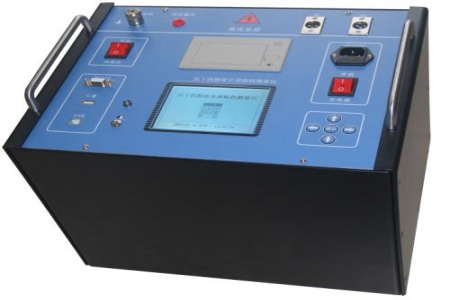
At the maintenance site of transformer on-load tap-changers, abnormal transition resistance measurements or incomplete waveforms often occur. During troubleshooting, it is necessary to consider whether the tester wiring, power supply, and parameter settings match the actual working conditions. The following explains, item by item, the issues that design and selection personnel should pay attention to from the perspective of maintenance and precautions.
The instrument has an open-circuit output voltage of 30V and can measure a transition resistance of 30Ω at 1A current. During selection, attention should be paid to the actual transition resistance range of the tap-changer. If it exceeds the instrument's measurement range, the test current should be adjusted or a suitable range should be selected. The measurement accuracy meets usage requirements within the 1-5Ω range; above this range, the acceptability of on-site error needs to be evaluated.
Transition time measurement depends on accurate identification of the starting and ending points of the waveform. During maintenance, the contact condition of the test clips should be checked regularly to avoid waveform distortion caused by contact resistance. For three-phase on-load tap-changers, the transition waveform of each phase should be recorded separately to ensure that the synchronization judgment is not affected by loose wiring in a single phase.
Three-phase synchronization reflects the time consistency of the switching action of each phase. Before testing, confirm that the instrument is reliably grounded to reduce the impact of common-mode interference on timing sampling. If strong electromagnetic interference exists on site, it is recommended to shorten the test line length and use shielded cables to reduce fluctuations in synchronization data.
The instrument adopts computer control and a dedicated measurement circuit. During long-term storage, it should be placed in a dry and ventilated environment to avoid moisture causing degradation of internal circuit performance. After each use, clean the test clips and check whether the insulation layer is damaged. If it has not been used for a long time, it is recommended to periodically power it on to check whether the open-circuit output voltage is normal.
On-load tap-changer testing must be carried out after the transformer is de-energized and reliably discharged. Operators should confirm that the tap-changer is in maintenance status to prevent misoperation. During testing, do not plug or unplug the test lines at will, so as not to damage the instrument's output circuit or affect the measurement results.
Design and selection personnel can check against the following items: whether the transition resistance measurement range covers the tap-changer under inspection; whether the transition time resolution meets maintenance standards; whether the number of three-phase synchronization measurement channels is consistent with the actual number of phases; whether the power supply method matches the on-site power conditions. After confirming item by item, make a choice based on maintenance convenience.

