
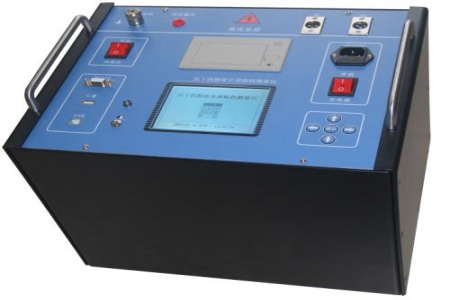
At substation maintenance sites, when facing insulation testing of large transformers, power cables, or high-voltage motors, technicians often encounter two types of problems: first, insufficient instrument output current, which leads to unstable measurement of absorption ratio and polarization index; second, the need to measure AC and DC voltage on site while having to carry multiple devices. To address these engineering pain points, the DRD-3mA Digital Insulation Resistance Tester integrates AC/DC voltage measurement and absorption ratio and polarization index calculation functions on the basis of insulation resistance measurement.
This model has a high-voltage short-circuit current of 3mA, making it suitable for insulation resistance measurement of large transformers, instrument transformers, generators, high-voltage motors, power capacitors, power cables, surge arresters, and other equipment. The 3mA output current helps shorten charging time when the test object has large capacitance and improves the repeatability of absorption ratio and polarization index measurements. The measurement accuracy is 5%, meeting the basic requirements of on-site engineering criteria.
In addition to insulation resistance, the instrument can measure AC and DC voltage, making it convenient to verify power supply status on site or assist in determining whether equipment is energized. The automatic calculation functions for absorption ratio (R60s/R15s) and polarization index (R10min/R1min) provide reference data for evaluating insulation moisture or aging. The operation interface is laid out according to engineering habits, reducing the probability of on-site misoperation.
In scenarios such as transformer maintenance, cable handover testing, and generator shutdown inspection, it is recommended to first confirm that the test object has been reliably grounded and discharged before connecting the test leads. When measuring the absorption ratio, keep the rotation speed or power supply stable to avoid affecting readings due to charging current fluctuations. The instrument housing and test leads need to be regularly checked for insulation condition to ensure high-voltage output safety.
Note: The above information and technical parameters are sourced from Yangzhou Darui Electric Co., Ltd. and are compiled and released by it.

