
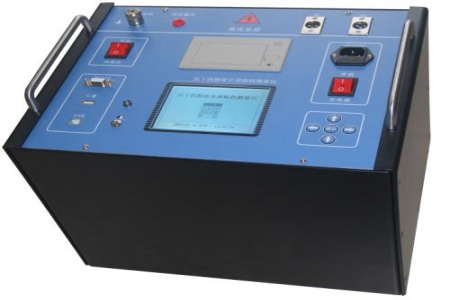
During on-site troubleshooting, it is common to encounter the same device measured with different instruments for insulation resistance, yielding results that differ by an order of magnitude. The problem often lies not with the device under test, but with the instrument's own output characteristics, range switching, and reading method. The DRD-5A insulation resistance tester is designed specifically to address such on-site deviations, making it suitable for technical engineers to use in handover tests and routine maintenance.
Some insulation resistance testers on the market use synthetic resistance methods for range switching. Limited by design cost and size specifications, this approach tends to introduce additional errors in the high-resistance range. The measurement circuit of the DRD-5A differs from conventional solutions. While ensuring controllable volume, it independently handles the high-resistance measurement range, keeping readings continuous near range switching points. The output current is approximately greater than 1.6mA, and the power supply range covers DC 7~9V. It can be powered by six 5# nickel-cadmium rechargeable batteries or charged via an external AC 220V power source.
Insulation resistance measurement often requires multiple records and archiving, and manual transcription is prone to errors. The DRD-5A supports power-off storage of 100 sets of measurement results, ensuring data is not lost after unexpected power failure and eliminating the trouble of repeated on-site measurements. The instrument features an RS232 serial interface for data communication with a computer, facilitating the import of test records into a management system, making it suitable for occasions requiring test reports. This function is not a default configuration in similar portable instruments, and for technical engineers, it can reduce the data transcription work between the site and the office.
Compared with traditional hand-cranked megohmmeters, the DRD-5A has no mechanical crank, provides stable output, and readings are less affected by the operator; compared with some digital instruments that only offer single measurement functions, its data storage and communication capabilities are more suitable for batch testing. It should be noted that instrument selection still needs to be combined with the rated voltage of the device under test and the required range, and cannot be decided solely based on portability.
Suitable for insulation resistance measurement of equipment such as distribution cabinets, cables, and motor windings, and can also be used by maintenance personnel for routine insulation status checks of high-voltage equipment. Before use, confirm that the range matches the voltage level of the device under test, and perform discharge and safety protection in accordance with regulations.

